



Date: 5 May 2026
Location: Brussels (in-person)
About the Event
The first European Brain Economy Summit brought together ~200 policymakers, industry leaders, academics, investors, and public figures from across the continent.
Our work with the McKinsey Health Institute contributed to a panel on women’s brain health—an area that deserves far more attention and investment.
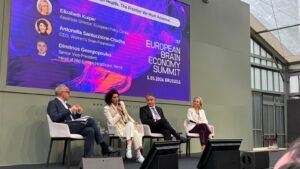
The economic case is equally compelling: investing in brain health could generate an estimated $50 billion return to global GDP by 2040.
It was a rare and valuable space to exchange ideas, challenge assumptions, and align on a shared direction for the future.
Why does this matter? Because in longevity societies, brain capital is becoming the major asset. It underpins productivity, resilience, innovation, and social cohesion.
Extending lifespan without protecting cognitive and mental health is simply not a viable path to sustainable growth.
Recognition to the institutions shaping this agenda, McKinsey Health Institute, Davos Alzheimer’s Collaborative, European Brain Council (EBC) and Women’s Brain Foundation, signalling a critical convergence between science, policy and industry around brain capital.
Why this matters is increasingly clear. In longevity societies, brain capital becomes the defining asset, shaping productivity, resilience, innovation and social cohesion. Extending lifespan without protecting cognitive and mental health is not a viable strategy for sustainable growth.
A particularly important discussion focused on women and the workplace, highlighting persistent structural gaps. These are not side issues; they are core governance challenges that directly impact workforce sustainability and economic performance.
The Brain Economy is no longer conceptual. It is becoming operational. I will be taking this agenda forward into the upcoming meeting at WHO Regional Office for Europe, as part of the Ageing is Living framework, where the focus now turns to how we translate these insights into governance models for lifelong health.